


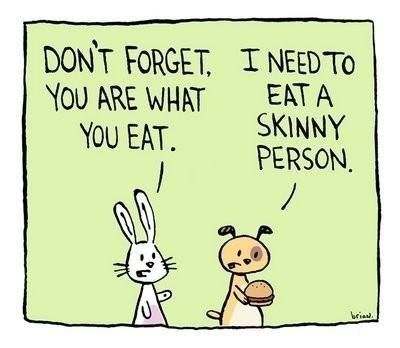
There’s a famous saying that goes: “You are what you eat”. But what if you don’t know what you are eating?
Do you know that:
- Some vegetable products are labeled as “cholesterol-free”
- But vegetables do not have cholesterol?
- Foods labeled as “natural”
- Only means that some ingredient(s) in the food is natural, but not all of it?
- Some candies come with the label “fat-free”
- But candies are almost 100% sugar?
Whether your goal is to get fitter or healthier, knowing how to read food labels is essential to help you make informed decisions (or at least give you a better idea of what you’re putting into your body).
Here are 5 steps on how to read food labels
Beware of health claims on food packaging
The health claims on food packaging may simply be marketing gimmicks aimed at selling the perception of healthy/healthier food by spotlighting the positives while diverting attention away from unhealthy aspects.
Even seemingly HPB-endorsed claims of “low-fat”, “lower in saturated fat”, “low-sugar”, “no-added-sugar”, “contains wholegrains”, etc. do not show you the complete picture.
- “Low-fat” food may come with more sugar.
- “Low-sugar” food may come with more fat and contain other ingredients similar to sugar, such as syrup, corn syrup, honey, etc.
- “No-added-sugar” fruit juice already has fructose – a commonly found sugar in fruits. The nutrition content of packaged fruit juices is very different from eating whole fruits, as fiber has been removed in the juicing process (try eating the same number of fruits to make a glass of fruit juice – I guarantee it won’t be an easy feat).
- “Contains wholegrain” just means some aspect (possibly minimal) of the food contains wholegrain, and not the entire product.
Read more about how to interpret the “Healthier Choice Symbol” in Singapore here:
https://vigeo.sg/how-to-read-food-labels-part-1-is-food-with-healthier-choice-symbol-really-health
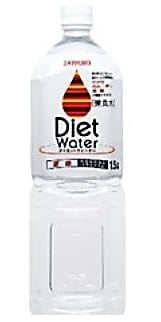
Beware misleading health claims – water is water is water.
You don’t need “diet” water for weight management.
Read the ingredient list
Ingredients are listed in order of their proportion. In other words, the ingredient present in the MOST quantity is listed FIRST, and the ingredient least present is listed last.
Tips on how to gauge the “healthiness” of food when you are reading food labels by looking at the quality and quantity of ingredients:
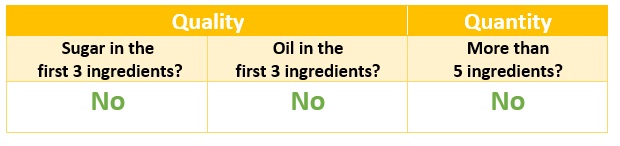
- Quality: Avoid food that contains the following within its first 3 ingredients
- Sugar – common variations include: high fructose corn syrup, syrup, molasse, agave, dextrose, sucrose, glucose, maltose, and lactose.
- Oil – common variations include: vegetable oil, hydrogenated vegetable oil, coconut oil, palm oil, palm kernel oil, and cocoa butter
- Quantity: If a food contains a long(er) list of ingredients, it is likely to be more highly processed. A good rule of thumb is to aim for foods with less than 5 ingredients. Food which contains only 1 ingredient is the best.
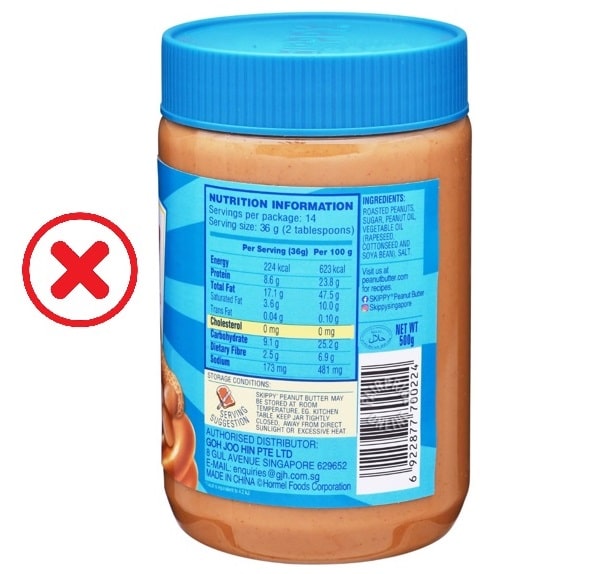
Example: Skippy Peanut Butter
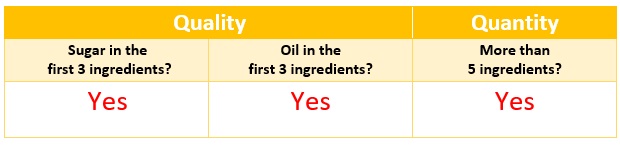
Example: Skippy Peanut Butter
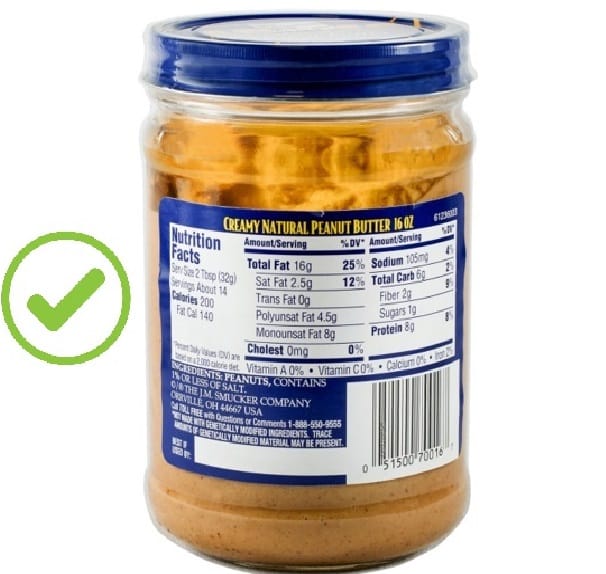
Example: Adam’s 100% Natural Peanut Butter
Pay attention to serving size and total amount per package
Do not be fooled by serving sizes, as manufacturers can reduce the serving size to make the amount of calories, fats, and carbohydrates appear smaller.
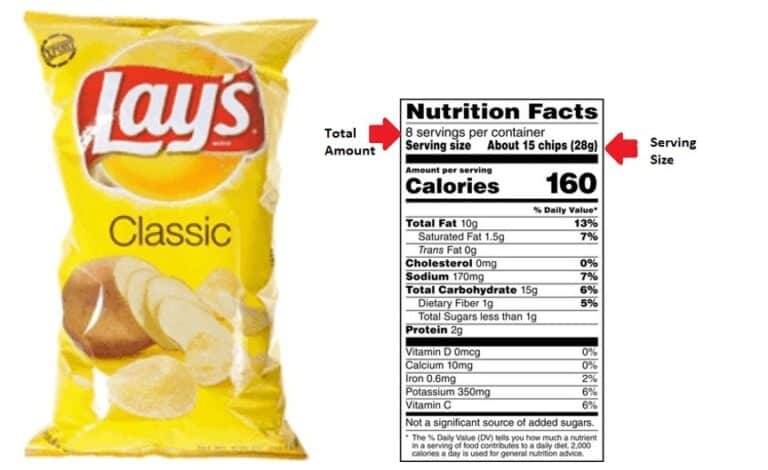
Example: Classic lay’s potato chips

Per serving of 15 chips gives you ‘only’ 160kcal, but the whole packet will provide you with a whoping 1280kcal.
To find out the total nutrition count in a whole package of food, take the amount per serving multiplied by the number of servings in one package. That will give you the full picture.
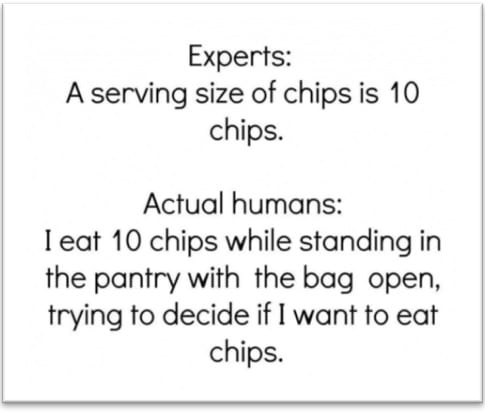
Can you stop at 10 chips?
Check for calories, fats, and carbohydrates
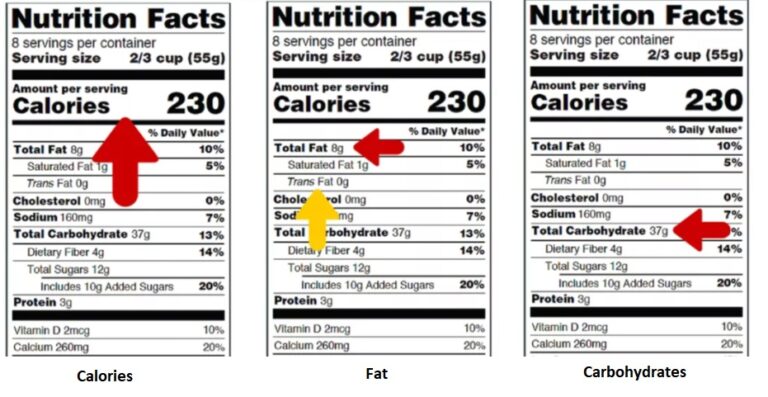
You can follow the above example on how to look the amount of calorie, fat, and carbohydrate in a serving when reading food labels, to see how they fit into your own needs and goals.
Remember: the above example is amount per serving size, so you will have to multiply that with the total number of servings in a packet, if you intent to finish the whole packet.
If your goal is to lose weight (or to avoid weight gain)
You should first look at total calories to see if it fits into your Daily Caloric Intake. So long as you eat within the appropriate Daily Caloric Intake for weight loss/maintenance, the proportion of fats and carbs in your diet is secondary.
To find out how you can lose weight (and keep it off) in Singapore, refer to this article:
https://vigeo.sg/how-to-lose-weight-in-singapore/
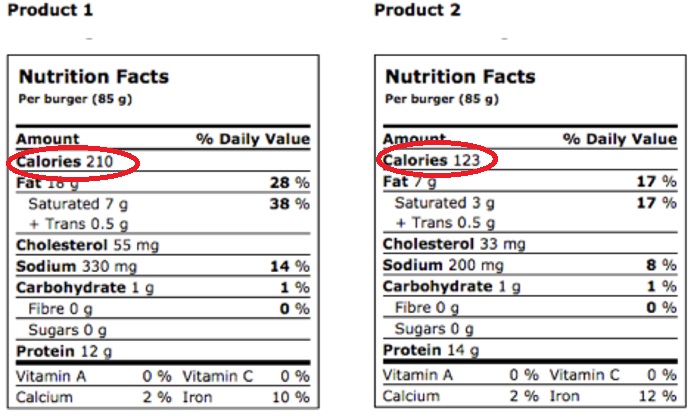
Fats and carbohydrates are not inherently bad. In fact, they each serve important functions in the human body:
- Carbohydrates: Our body’s main source of energy that helps fuel our brain, kidneys, heart muscles, and central nervous system.
- Fats: Are essential for hormone regulation and overall health.
However, if you are keeping to a specific Daily Caloric Intake, you can choose lower carbohydrates or fats (but not both) according to your dietary preference.
If your goal is to achieve general health
You can refer to the % Daily Value (% DV) as a general guideline for an average 2000kcal/day intake that is available in most food labels. Aim for foods with a smaller % DV (except for vitamins and minerals) to minimize your risk of overeating (remember to also take serving size and total amount per pack into account).
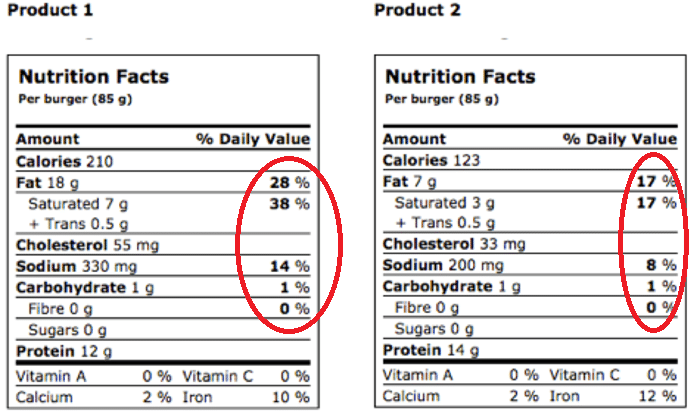
Looking at % DV, Product 2 has lower % DV for calories, fat and sodium
The next section on quality of nutrients will help you determine which nutrient marker you should pay attention to, to choose food that is better for general health.
Aim for higher nutrient quality
Food is more than just calories, carbs, and fats. The quality of nutrients may have an impact on your health and fitness.
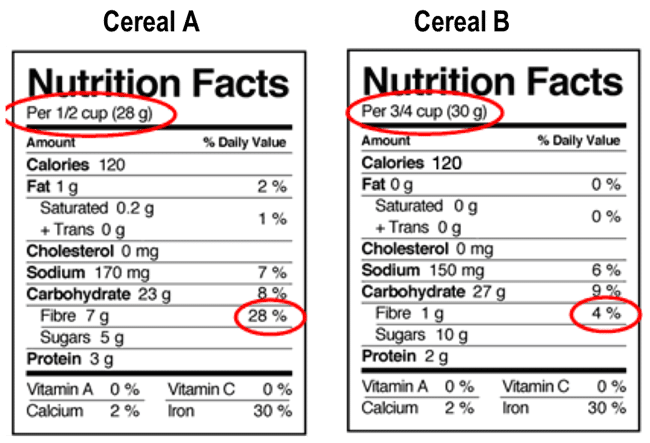
Both kinds of cereal have equal amounts of calories, but cereal A has more fibre for the same serving size
Here are some tips on what to look out for when reading food labels:
Minimize food that contains
- Unhealthy oils and fats
- Such as hydrogenated or partially hydrogenated oil, saturated fat and trans fat
- High amount of sodium
- More than the recommended amount of 2300mg per day
- High amount of sugar
- More than the recommended amount of 24g per day for females, and 36g per day for males
Maximize food that contains
- Dietary fiber
- Helps you stay full and avoid overeating
- Higher in protein
- Helps you to stay full longer and requires more calories for the body to break down, compared to carbs and fats
- Higher in vitamins and minerals
- Such as vitamins, calcium, and iron
Summary
- Beware of health claims on food packaging – they do not show you the full picture.
- Read the ingredient list – ensure that it contains good quality and quantity of ingredients.
- Pay attention to serving sizes and total amount – be aware of how much you are consuming.
- Check Calories, Fats, and Carbohydrates – depending on your goal, aim for lowest number accordingly and/or % DV.
- Aim for higher nutrient quality – minimize oil, sodium and sugar & maximize fibre, protein, vitamins and minerals.